22 February 2022

LOOK: Amplifying Black Voices: 100+ Black Photographers


It is valuable to view history and modern times through different lenses and different perspectives. 

Here are just a few...

"Amplifying Black Voices: 100+ Black Photographers You Should be Following on Social Media" (PhotoShelter.com)


There are many more photographers and links, and a search of 'prominent black photographers' (and the like) will lead you to them. 

Be curious. :)


18 February 2022

PROJECT #2: LIGHT & SHADOW (24+ Photos)

#2: LIGHT & SHADOW (24+ Intentional Images)

DIRECTIONS: 
Make 24+ intentionally well composed photographs of distinct & dramatic LIGHT and SHADOW in your daily life over the next six days.

THE CHALLENGE:
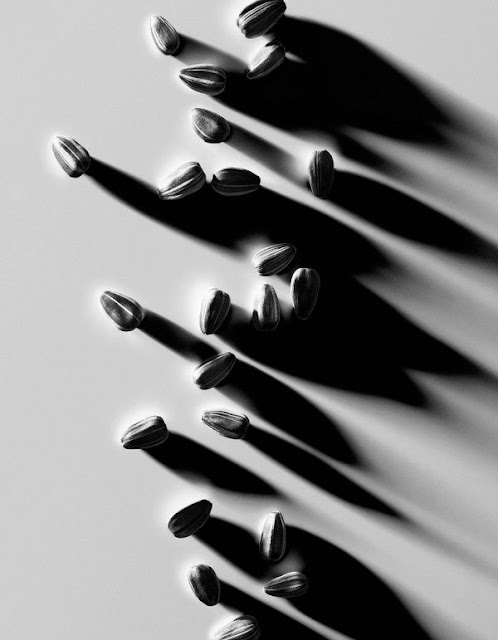
Make images that have beautiful...striking...sublime...gentle...nuanced...stark...etc...light and shadow.  What/where/when/who is secondary to the light. Light is the main subject, with what/where/when/who being secondary. 

TO CONSIDER:
-Approach the project as a project of observing how light illuminates spaces and places, bounces/deflects off surfaces, creates highlight and shadow...
-Think about the composition. Is it symmetrical or asymmetrical? Could you compose in rule of thirds? Some other compositional order? 
-Identify the direction of your light source.
-Silhouettes?
-Side light / direct light portraits?
-Something else you have yet discovered...
Robin Broadbent
Robin Broadbent

Olavo Azevedo


10 February 2022

PROJECT #1: MACRO REVISITED

DIRECTIONS:
1. Make 16+ (8+ in class/8+ out of class) macro images of texture, surfaces, small objects, etc. 
2. Develop/process images in Photoshop &/or Lightroom (the number is yet to be determined)

EXTRA CREDIT CHALLENGE OPTIONS:
  • Photo of water droplets where the background is visible THROUGH THE DROPLET.
  • Photo of the iris of an eye (human or animal) - Be careful. 


12 TIPS FOR MACRO PHOTOGRAPHY ON YOUR PHONE

WHAT IS MACRO?

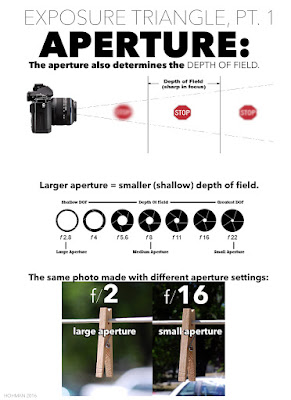
APERTURE=the opening into the camera.
APERTURE also allows you to control what is called DEPTH OF FIELD. 
DEPTH OF FIELD refers to how wide an area is in focus.  


The purple area represents what is in focus, 
and the lenses show you the aperture setting needed for THAT particular sliver of focus. 

MACRO photography refers to close-up photography.
A lot of macro photography is done with specialty lenses.
However, you can probably make them with the macro setting that is included on most cameras. 

This is the symbol that denotes close-up/macro mode on point-and-shoot cameras:


DIRECTIONS FOR DSLR CAMERAS: 
A.  If you have a DSLR, you might have a MACRO setting (the flower). If so, use that setting. If not...

1.   Set your mode to "A" for "aperture priority." 


2.  Then, set your aperture to as WIDE OPEN a setting as possible. That means, the SMALLEST f/stop number. Look at these aperture sizes in relation to the numbers below them:


Notice how the smaller number, f-1.4, is the WIDEST OPEN aperture setting.
This will give you the smallest sliver of focus possible with your lens (small/shallow depth of field).

3. If you are in Aperture Priority setting, your camera will then set the shutter speed to compensate for the wide open aperture. 

B. If you are working with a point-and-shoot camera, or a phone camera:
1. Set your camera mode to the "macro" function: 

2. If your phone does not have a macro setting, experiment with moving the a bit farther away from the subject, but zooming in a bit. It will take some adjusting, but you can get it.

EXAMPLES/INSPIRATION

Some creative macro: